Friday, January 10, 2020

Be kind. Be loyal. Believe that you are brave: Ongoing life lessons from the sweetest girl in the world


The sweetest girl in the world and I talked a lot. Or rather, I talked; she listened. 

We'd see the headlights of a car during our predawn walks, and I'd tell her, "Just think. That driver probably had been complaining about having to get up so early, and now can't wait to get to work or school to tell everyone, "I saw the sweetest girl in the world this morning!"


I'd fling open the front door after going for a swim or struggling through a spin class, announcing to her, "I thought about you the whole time I was in the pool/at the gym!"

If she was snoozing in the sun, I could only get three words out -- "sometimes a girl..." -- before she'd immediately rouse herself, not even waiting for the next words, "has to go for a walk. She just has to."

So we'd go. As if she hadn't heard it a half dozen times already that day, I'd remind her that she is indeed the sweetest girl in the world. Not only that, I'd say, "You're also the most loyal...the most kind...the most beautiful...the most courageous."

At times, she didn't believe the last one. Storms scared Angie, and she always seemed kind of embarrassed to seek shelter in a closet, or to not-so-casually stayed glued to our legs. 

But before we filled out each others' lives, she'd been deserted on a country road, where she lived for a week before being lovingly lured away by a wonderful rescue group. For those seven days, though, who knows what weather she endured while waiting for whoever dropped her off to return? 

So whatever her response when the barometric pressure rose or dropped or whatever it does before a storm, or however she huddled once it hit, I reminded her how much courage it took to stay put waiting...and that she never had to worry about storms or anything else again. Worrying was my job, I'd tell her, and I was very good at it.


We said goodbye to our precious girl two days after Christmas. Outside my window right this minute, the rain is so loud and the lightning so bold and I miss her more than ever. This is the first storm we've had since she died, and I want to look after her. To remind her that I do the worrying around here. To assure her, most of all, that she is most courageous girl I've ever known.

I may have been the one who did all the talking, but Angie had much more to say than I. She reminded me that it was OK to be afraid, and to turn to those we love when we need reassurance and comfort. 
And when I'd tell her she is the sweetest, the bravest, the kindness and most beautiful girl in the world; when I'd exalt her big heart and pure spirit, I'm realizing now that I was also reminding myself of the person I need to be.

Now that Angie has left this sweet earth, I miss touching her while talking to her. But we still have conversations. These days though, I'm the one who's listening.

Thursday, October 31, 2019

The choreography of CPR: How my co-workers at the Richardson YMCA saved a member's life

Nick Echtenkamp, Ashley Eger, Samantha Buehler and Mica Nix: The Y heroes who saved a member's life.

At the Richardson Family YMCA where I work two afternoons a week, my co-workers saved a man's life. 

That's what it all boils down to, this 10-minute choreograph of care and compassion; of knowing what to do and doing it without hesitation; of trusting your own instincts as much as you trust those of everyone surrounding you:

Saving a life.

That's what my supervisor, Mica Nix -- instrumental in conveying calm and breathing slow, steady breaths into a stranger's lungs -- told her husband and four children when she came home that evening.

"I wasn't sure what I'd say to them," she tells me later. "But when I walked in the door, I just said it. 

" 'You know what? I saved a life today.' "

Her husband cried. So, quite honestly, did I, and I wasn't even there. I'd been scheduled to work Tuesday; my shift would have started 15 minutes before an astute member noticed an older gentleman who appeared to be sleeping on the stationary bicycle. 

But I'd woken up that morning feeling lousy, so had called in sick. When I came in the next day, my friend and co-worker Ashley Eger -- who just happened to be working out on her day off -- told me what had transpired just 24 hours earlier.

Mica approached the man, noticed his tongue was out and he had no pulse. 

"I tried to wake him, but he wasn't responding," Mica says. "I yelled at Ashley to go get Nick."

Nick is Nick Echtenkamp, our executive director. He's been CPR certified for decades; has lost count of how many people with whom he's shared his knowledge. But this was his first time to actually perform it.

"Mica and I just fell into step," he says. "She did A and I did B. Then I'd do A and she'd do B. We just knew what to do. You go over it and over it and when the time comes, everything just kicks in."

Meanwhile, Jessica Miller, who works at the front desk, called 9-1-1. Ashley and another member named Chris moved a half-dozen exercise bikes out of the way so Mica and Nick could lower the member to the floor to start CPR. 

"The bikes weren't heavy," she says thoughtfully, as if the enormity of it all is just hitting her, "until we moved them back."

Samantha Buehler, program director of family programs, got the AED from the wall; the machine did its calculations, determining the man needed CPR, not an electric shock. Sam handed Mica a mask from the red bag holding the AED.

Nick, meanwhile, had assessed the situation: Were the man's airways open? Yes. Was he breathing? He was attempting, but it wasn't working. Did he have circulation? He had no pulse. 

So Nick put one of his hands atop the other and began staccato, rhythmic compressions on the man's chest: One-two-three-four-five...Mica counted till he reached 30 and stopped. Then she took a deep breath, exhaled her air into the man's lungs, and did it again.

Nick's turn: 1, 2, 3, 4, 5...30 compressions. Now Mica's. 

After two rounds, the man started coming to; he began breathing. He opened his eyes.  

"I held his hand," Mica says. "When he regained consciousness, he squeezed it and smiled. I'll never forget that."

Everything she'd been taught, everything they'd all learned, everything they had practiced in their subconscious over and over and over -- all kicked in. The paramedics arrived; the ambulance took the man to the hospital.

"It all worked out," Mica says. "It all worked out where we were. I think God puts people where they need to be for them to help. Everyone figured out what their role was."
We never know, do we, what will happen from one moment to the next and change our lives forever. We could trip on a curb and crack our head on the sidewalk. We could turn a corner and meet the love of our lives.

Or we could go into the YMCA to ride a stationary bike for a half hour and have a heart attack.

On a sunny Tuesday afternoon in October at a small YMCA in Richardson, Texas -- where everyone who works there is CPR certified -- that's just what happened.

My heart still pounds at the thought of it all. And thanks to these amazing people surrounding me and surrounding one special elderly gentleman -- his heart is still beating, too.

Wednesday, October 30, 2019

Thanking my son Charlie on his 26th birthday for never saying, "Please stop writing about me."


The first time I wrote about Charlie for public consumption, he was a newborn. Needless to say, he had no objection. 

Twenty-six years and probably millions of words later, he has yet to ask me to stop. For that, and for oh so much through the years, I thank him. 

Here's a sampling of what I've shared about him through the decades; in other words, what he's amicably gone along with. They start when he's in high school, about the time I started this blog. I wrote others in The Dallas Morning News, which, sadly, I think are lost for the ages. 

So I'll focus on what I have, and hope you enjoy them as much as I savored writing every word.


My apologies for getting a little carried away!


On getting his head shaved (for the first time)


On muddying up with a friend

On relying on relay partners


On not having another (whew!)

On being a friend and a brother

Saturday, July 20, 2019

When your first friend from first grade gets married, how you could be anywhere but there?


The kid on the right got married last week. The one in the middle was his best man. 


Lee Hanig (whom I have long thought of as my son) and Charlie (who really is) have been friends since first grade at St. Mark's School of Texas. Charlie's last name starts with a G and Lee's with an H, so there ya' go. 


The boys remained close through lower school and middle school, playing on the same or opposing sports teams; going on birthday campouts at my parents' farm (where the picture above was taken with my other all-but-son, Luke Smith); laughing and whispering and being total goofballs.


Then after Lee performed at the ninth-grade orchestra recital, he told Charlie he was leaving St. Mark's to attend Booker T. Washington School for the Performing Arts. Charlie, who did not inherit even a sliver of his mother's crying gene, cried and cried. 


"It shattered my world," he says.

The next few years, the two played a little club volleyball together and both worked at The Purple Cow restaurant. Keeping up a friendship while in different high schools and having different interests, though, is challenging. Their college choices were thousands of miles apart; their experiences about as spread out, too.

Still, friends are friends; brothers (which is what Charlie considers Lee to be) brothers. And months without communication, they discovered, can be finger-snapped away by sharing a cabin in Colorado.

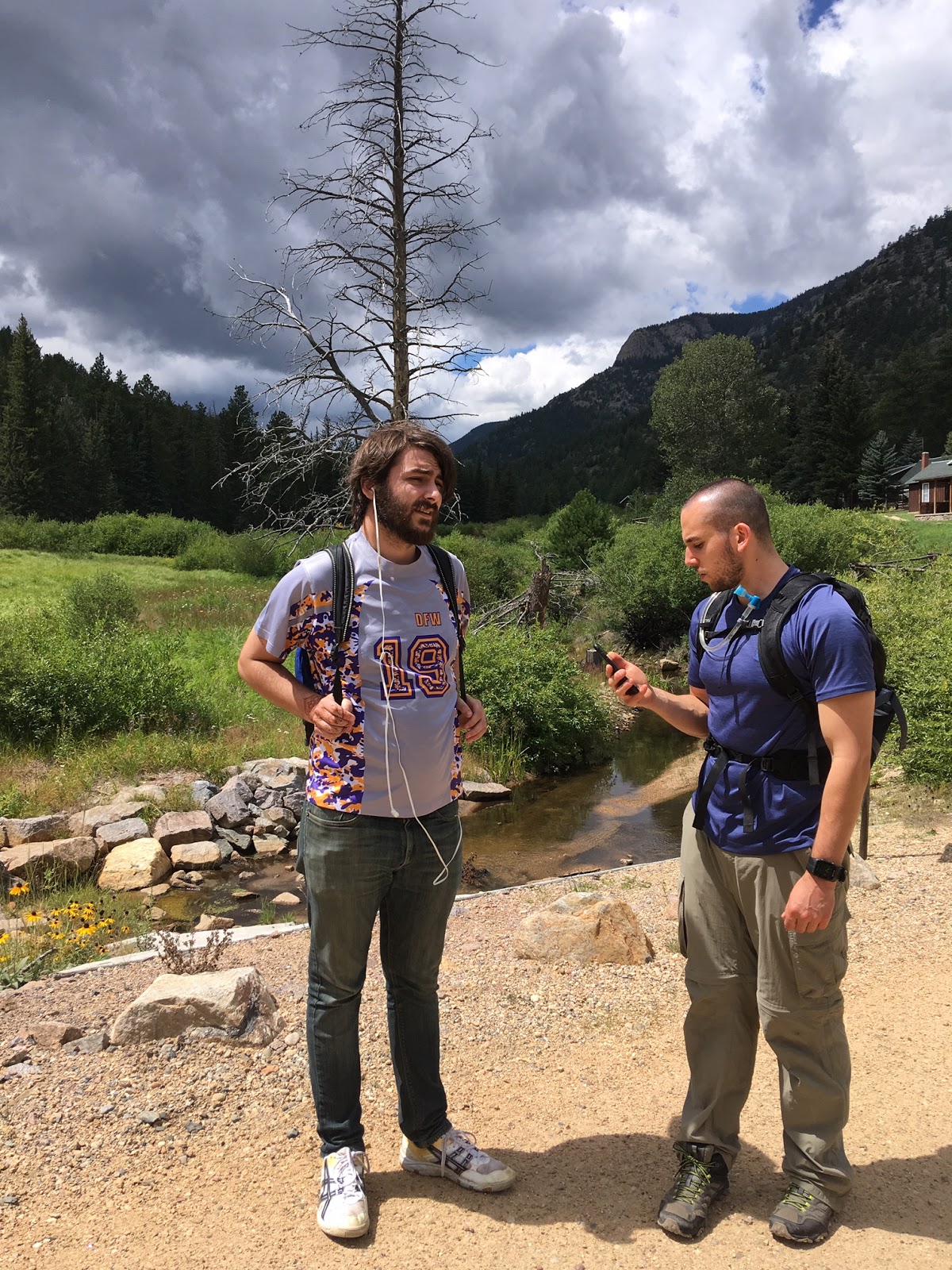
The first time Lee went with us to the YMCA of the Rockies, he and Charlie were a month away from third grade. The most recent was two summers ago.


As a hiking kid, Lee amused us with his lollygagging, all the while licking on giant lollipop for sustenance. As a hiking adult, he sped up a little, switching to one giant baguette to sustain him for miles- and hours-long hikes. Charlie's backpack, on the other hand, was crammed with thick meat-and-cheese sandwiches, fruit, protein bars.


My family has always adored Lee. He is so...Lee. 

I can't remember him calling me, my sisters, brothers-in-law or my mom by anything other than our first names. While in Colorado with us, he immerses himself in the general hilarity of game nights; does jigsaw puzzles by the hour to the delight of my mother. He plays his guitar and sings with no prodding, also to the delight of my mother.


Lee played the guitar at my niece Julie's wedding, which was held at the Y of the Rockies. Lee is the one who told my mother that yes, we could stop at a dispensary ("I'm curious," Mom said) to just look around. But he put his foot down at her buying a lollipop and most certainly at trying to take a plant on the plane home ("I just want to see if I could grow it.")

Charlie last saw Lee almost two years ago. Charlie had stopped in Boston, where Lee and his then-girlfriend Fran lived, on the way to visit my brother and sister-in-law in Maine. 

When Lee and Fran got engaged earlier this year, he asked Charlie to be one of his groomsmen.

Charlie initially said a resounding yes. But this year has been kind of tough for us financially. Charlie's part-time job doesn't leave much for extras, and a month ago, he had to pay $700 for his car's air conditioning to be fixed. I was laid off in January and couldn't be much help. 

So Charlie called Lee to tell him he wouldn't be able to swing a trip to Boston. I knew Charlie was disappointed, but he assured me it was OK. He'd record a toast; Lee's mom Deb said she'd make sure it was shown at the rehearsal dinner.

Then around noon on Saturday, 18 hours before the wedding, I read the toast Charlie had sent me. It made me cry. I called my sister Susan and read it to her. And maybe one of us said it first; maybe we said it in unison. But the crux was this: "Charlie has to go to Lee's wedding."

So he did. We found a fare that wasn't outlandish and Deb said Charlie could share a hotel room with her brother. Charlie and I dashed out and found a suit on sale; alterations were completed by 7 p.m. Charlie boarded his flight 12 hours later and arrived in Boston four hours before the wedding to be Lee's best man.

Deb and Fran knew Charlie was coming, but Lee didn't. In true Lee fashion, he didn't seem all that surprised. But during the ceremony, Charlie told me, Lee turned to him and quietly said, "I'm so glad you're here."

And in a Facebook note the next day, Fran wrote: "Lee was so happy Charlie was there."


So there you have it. No moral here, unless it's that elbow to your ribs reminder: No one knows you as well as your childhood friends. I started to say "other than family," but maybe they know you even better...and maybe that's because they are family.

What else can you do but make sure those mountains and miles and laughter and tears and teams and games and sandwiches and baguettes -- that they all count for something. Something strong, something beautiful, something everlasting. 

And you go ahead and spend money you don't have; you say thank you to a couple of loved ones for being so generous. Because this is one of those times when you just have to be there. For friendship. For brotherhood. For love. 

Thursday, July 11, 2019

Seizure-ing the day

For a few weeks, perhaps a month or so, after my son Charlie had a seizure and spent three days in the ICU, I kept a keen, not always subtle, eye on him. That wasn't hard, because he wasn't allowed drive for three months and thus, was in my passenger seat a lot.

His neurologist -- whom we adored anyway, but even more so because he gave us good news -- was all but certain Charlie wouldn't have another seizure. But in the hospital last year, those days and nights, heart-lifting though they turned out to be, also had plenty of scary moments. Plus, being a worrier in general, I sometimes had to bite my tongue to keep from asking, "Are you OK?" too many times within a day.

There was no telling what had caused everything to go a little haywire in Charlie's brain. Maybe it was stress. Maybe exhaustion. Or, as Dr. Ronald Bell, his neurologist, said, "sometimes it feels like an act of God."

We non-medical types stopped trying to figure it out, stopped starting our sentences with, "I wonder if it could've been..." We just stepped back and let time pass. Charlie was given the OK to drive. He moved back to Colorado, where he immersed himself in working and in hiking as he had for the two previous summers.   

I loosened my grip on those remembrances and worries I had grasped so tightly, gently wrapping each in a box labeled "yesterday." I knew where they were, but unless something jolted my memory -- brushing up against the shirt I was wearing the morning Charlie had his seizure, perhaps -- they simply stayed in their little cocoon.

They began rustling just a little when Charlie moved home from Colorado in January. He was taking classes at TWU, studying to become a personal trainer, working about 30 hours a week at a German delicatessen. He was going to the gym after work, getting home around 10, eating late, and getting less sleep than I wanted to know about.

The week of July 4, Charlie was scheduled to work seven days in a row, and I could all but hear the jostles of that wrapped-up box of remembrances and worries. Charlie was exhausted; too tired even to exercise, which was so unlike him. July 3, he started work at 6 a.m., had barely 20 minutes to eat his lunch, and got home around 4:30. 

A couple of hours later, while I was having dinner with Mom and my sisters, he called.

"Did I work today?" he asked. And then, "Do I work tomorrow?" And then, "I don't remember driving home."

I left the table and rushed home. At first Charlie said he felt better, then complained of a headache and threw up. I called his internist, who said, "Something's not right." 
A wiped-out Charlie awaits test results while camped out in the rather chilly ER.
Charlie, his dad and I spent five hours in the emergency room, where Charlie had a CT scan and a huge IV dripped its contents into his body. We came home well after midnight and, I confess, Charlie slept in my bed and I slept on the floor next to it.

Five days later, we went for a follow-up appointment with his neurologist. Dr. Bell told us stories of his trip to Ukraine, and gave us a primer on European and Russian economics. We were held rapt, as we had been every time he came to Charlie's hospital room -- never in a hurry to leave; always a wealth of brain talk and fascinating stories. 

All this to finally say that Charlie is fine. Dr. Bell attributed Charlie's symptoms to heat stroke and to dehydration. Take breaks at work, he told Charlie. Sleep more. Make sure you drink plenty of water.
Charlie and Dr. Ronald Bell, his neurologist, sharing good news.
On the way home, Charlie -- who has been a bit in flux about what he wants his future to hold -- told me he has decided to return to Colorado. I am, quite honestly, thrilled. 

His decision, I believe, is a thank you of sorts -- to God, or perhaps to fate. To the stars. To the universe and, of course, to our beloved voice of calm and bearer of good news, Dr. Bell. 

What each or all of them bestowed upon Charlie is way more than an all-clear. Instead, it is a nudge, a wink, an admonition: To go where your heart is. To pursue what moves your soul. To revel in what quenches your spirit. 

So what better way to express utmost gratitude than to do just that?
Charlie, delighted to be 13,560 feet above sea level.
My carefully wrapped and stowed-away collection of worries has been silent since Charlie's follow-up appointment. And as tempted as I am to lug to the dumpster this box that only I can see, I'm instead going to let it stay where it is. 

Those three days in ICU were wrenching. Without a doubt, I have never, ever, ever been as scared in my entire life as when I found Charlie unresponsive after he had his seizure. I pray we never have to go through that again.

But you know what? It happened. And we came through. So I'm keeping that box, which holds more love and grace, more caring and smarts that I will never quite grasp. For that, I am beyond grateful. 

Which is why you couldn't begin to pry that crazy box from my soul, and certainly not from my heart.


Sunday, June 16, 2019

Essays about and for my dad on this, our seventh Father's Day without him


Above all else, my father loved his family. 

Almost as much as us, he loved Father's Day. He loved his birthday. He loved Christmas. He loved being with those of us who adored him, who hung on his words, who got the hugest charge out of him.

He loved, quite frankly, being the center of attention...or being so very happy for one of us that his cup, as he'd say, runneth over. Such was the case in this, my favorite picture of him, taken at my brother Ben's wedding.


Dad's last Father's Day was in 2012, which my sister Susan and I are celebrating with him here. Our sweet Daddy died 46 days later.  


Not a day (or even half-day) goes by that I don't miss him; don't hear him jingling coins in his pocket, don't hear him saying "I love you" (which he did all the time) or quoting poetry (which he also did all the time). 

He's still the first person I want to tell so much to, or to ask about something. Nobody told a story like Dad, and though I probably heard most of them about a million times, I'd give anything to hear even one of them one more time.

Through the years, I've written a lot about him. He was just so...quotable. Endearing. Engaging. Loving. 

So perhaps as a gift to him, here are a few of my favorite essays I've written about him on this, my seventh Father's Day without my dad (a.k.a. the All American Boy, Mr. Wonderful, Dadaw, the Grand Poopaw).

Happy Father's Day, Daddy. 

On his ah...determination (OK, stubbornness):

https://aglassoflemonade.blogspot.com/2010/03/thinking-twice.html

On living life joyfully
https://www.dallasnews.com/life/better-living/2016/12/30/find-moments-joy-open-new-year-possibility

On oatmeal and hospital visits:

https://aglassoflemonade.blogspot.com/2012/02/appreciating-dad.html

On his optimistic attitude, even while in pain

https://aglassoflemonade.blogspot.com/2010/10/taking-away-pain.html

Six days after he died:

https://aglassoflemonade.blogspot.com/2012/07/searching-in-sun.html

Our first Thanksgiving without him:
https://aglassoflemonade.blogspot.com/2012/11/reaching-for-dad-in-thanksgiving-sky.html

After he'd been gone a year:

https://aglassoflemonade.blogspot.com/2013/07/circling-back-dancing-however-clumsily.html

On his connection to Miss Inez the organ player and Tennessee Waltz:

https://aglassoflemonade.blogspot.com/2014/12/tennessee-waltzing.html

On why I missed him especially at the 50-year anniversary of the JFK assassination:

https://www.dallasnews.com/news/jfk/2018/11/20/moment-1963-changed-fathers-life-familys-life-world

After he'd been gone five years
https://www.dallasnews.com/life/better-living/2017/08/01/five-years-dad-died-imlifted-love-reminders-matters


If your dad still shares this sweet earth with you, give him an extra hug today. If he's gone, may you revel in the relationship you had, and hear his laughter all over again.

Saturday, March 16, 2019

My son had a serious seizure a year ago. I'm finally ready to wear the shirt I was wearing when it happened


One of my favorite running shirts has hung in my closet, unworn, for close to a year now. The last time I plucked it off a hanger and put it on, preparing for a few Saturday miles, was March 17, 2018.

It’s what I was wearing moments later when I heard a strange, loud, guttural sound coming from my son Charlie’s bedroom and rushed in to find him under the covers, stiff and unresponsive.


It’s what I was wearing when I screamed to the 911 operator that I thought Charlie was dying; what I was wearing when paramedics and police officers filled our house; what I’m wearing in this photo his dad took of Charlie's uncles and me standing (and more than a little shell-shocked) next to Charlie’s bed in the ER at Methodist Richardson Medical Center.

It’s what I was wearing during tests to confirm Charlie had indeed had a seizure; what I used to absorb wayward tears when the tissue box was out of reach. It's what I took off that evening and hung in my closet, really not thinking about when I'd next put it on. An hour seemed a lifetime away; I couldn't even think about a year passing.

And 365 days later, it's still hanging there. I may brush against it as I pull out a different long-sleeved shirt to wear; may swipe it to the side as I opt for another.
The shirt (and, admittedly, a quarter-size spot of dried blood on the wall by the front door which Charlie insists on not painting over) are the only tangible memories of those four scary and ultimately life-affirming days.


There are, of course, plenty of mindful memories, which have been flooding my heart this past week. They tend to be of utmost gratitude -- first and foremost, that Charlie is healthy and has had no repercussions nor needed any medications. They're also for my family; for friends and strangers who prayed for him; for the staff at Methodist Richardson who made us feel like he was the only patient they were taking care of.

Still, as this auspicious and joyful anniversary approaches, I confess to mornings when I surreptitiously peek at Charlie while he's sleeping to make sure he's...well, you know. Breathing.

I also confess to following -- in my heart at least -- my sweet son's shadow, so close to him that I almost step on the back of his workout shoes; so close I'd collide with him were he to stop short, turn around and see me there.

My family and I (Charlie was out of it much of the time) will never forget those moments, those hours, those days of uncertainty and ultimately of exhilaration. We have learned that life really can change in -- feel free to mouth the cliches with me -- the blink of an eye, the snap of two fingers, the switch of a light. And for us, in an electrical current gone crazy in a healthy young brain.


Six weeks after his three nights in the ICU, Charlie went back to Colorado. He worked there for eight months, hiking hundreds of miles, lifting weights, spending time with friends. And, I'll venture to guess, not thinking for a moment about the seizure.

I don't harp on it at all, really. Still, I do think the whole experience has given me the gift of perspective; it's helped me keep to a minimum any angst about money or losing my job or wondering what the future holds.

For that odd little gift and for oh so much more, I am grateful.

The Mother's Day after Charlie had his seizure, I wrote an essay about our experience for The Dallas Morning News. In it, I recounted a conversation I'd had with his neurologist, Ronald J. Bell, MD, who is on the medical staff at Methodist Richardson. Charlie had a follow-up appointment, and as we left Dr. Bell's office, almost as an afterthought, I asked this question:

Charlie with Dr. Ronald Bell, his much beloved neurologist
"Did you pretty much know when you first saw Charlie in the ER that he'd be OK?"

His answer surprised me. "Not at all," he said. "I don't know the punch line. All I know is to take the next step."

Which is why, next time I run, I'll reach into my closet and, without even thinking about it, take my brown shirt from the hanger. I'll put it on for the first time since March 17 a year ago and then head out.

Oh who am I kidding? Of course I'll think about it. And with each step, my heart will beat out a thank you. Over and over and over again.

Monday, July 25, 2016

Reveling in the cool factor that IS Table 7


At the rehearsal dinner of our nephew Sam, my sister Susan and I were assigned to Table 7. There was quite a crew in the restaurant -- family of the couple, including Sam's two grandmothers; wedding party members and their significant others; a handful of clergy members (including some who had traveled from Wisconsin, where Sam attends seminary), plus Sam's and Katy's siblings.


Sam has two sisters and a brother. Katy has a sister, plus several step-relatives, eight of whom also had Table 7 seat assignments. 

Susan and I meandered through the crowd to our large round table in the corner, and we all introduced ourselves. It took a little repetition and a few pssst! Remind me who that is? -- but we finally figured out who went with whom and a little about each other.

Conversation was polite and nice and friendly, of course. And then -- what was it? What was that turning point that changed everything? It could have been when we sat down and Susan almost immediately proclaimed us to be "the renegade table." That did make us all smile and put us at ease and maybe even set the tone. But I'm not certain that was the moment I'm seeking.


Maybe it was glancing at the other tables, wanting the familiarity in Tables 1, 2, 3, 4, 5 and 6 to be in Table 7 as well. Or, most likely, it was a combination -- a sprinkling of serendipity, mingling with the fairy dust that seems to hover over happiness venues.

Whatever it was compelled Susan to make a proclamation: "We need to be known as the fun table," she said. "On the count of three, everyone start laughing really, really hard."
So we did, which of course made us laugh even harder. Other tables looked over at us, amused. That opened us up and we kept talking and talking, feeling this mirth that just seemed to grow. At one point, one of the bridesmaids moseyed over from another table and said, "You all are having so much fun, I just had to come over and be close to all this."


I said we needed to set up a Table 7 Facebook page. Susan decided that at the wedding reception the following evening, someone should request "Uptown Funk" and when we heard it, we'd all run to the dance floor.

The toasts to the happy couple ended; the stories and memories and hoo-haws and tears stopped, and we all went home. 

The following afternoon, the wedding was beautiful and joyous. At the reception, we acknowledged the presence of fellow Table 7-ers with a wave, a smile, or with seven fingers extended. The first time "Uptown Funk" played was early on, and everyone was too busy talking or mingling or eating to dance. 

An hour or so later, the bridesmaid who had come by Table 7 the night before found Susan and me eating dinner. 

"Table 7, right?" she asked. We nodded.

"I asked the DJ to play 'Uptown Funk' again," she said. "He said he doesn't usually repeat songs, but he will if you promise to dance." Then she said, "When I get married, I want Table 7 there."

We were, quite honestly, kind of weary. But after hearing that, how could we possibly say no? We looked at each other, nodded a little, and told her that sure, we'd get out there.


When the music started, suddenly our whole Table 7-ers were next to us. We sashayed onto the dance floor, and one of us (I like to think it was me) suggested a conga line. I reached for Susan's shoulders, and she weaved us around the other dancers -- even under a bridge of raised arms, where we were going the opposite way of everyone else.

But did the Table 7-ers care? Darn right we didn't. I laughed the hardest I had all evening; at one point, I turned around, and seeing our tablemates doing our crazy snake dance behind me made me laugh even harder.

When the evening ended, when guests were handed wands of streamers and bells and lining up to cheer on the newlyweds, Susan and I saw two fellow Table 7-ers. We joked about one day running into each other in a restaurant or anywhere else, and how we'd all just say "Table 7!" and start dancing.

Susan said, "Or if you're ever feeling down, just say out loud, 'Table 7.' You never know who might be around."

"Table 7," said Landon, one of Katy's stepbrothers, "is a state of mind."

What more can I add to that? Except that when you sit at a table of renegades, you just gotta be open to laughter and to mirth. Because only then can you feel it -- that subtle sprinkling of magic; that fairy dust which brings us together, and which keeps us whole.


Sunday, August 9, 2015

Hiking heaven

We took the hike because that's what you do when you're in Colorado. It's what we do, anyway, because the mountains call out to us. And if we don't answer, if we get too caught up in just ogling their snow-capped loveliness, our allotted time here passes and we're left grasping for them with a sense of desperation, the what-ifs settling over our psyches like impending afternoon storms.

In their bountiful altruism, the mountains extend a magic looking glass in front of our faces, giving us a chance to flash forward a week, a month, six months. 

Will just being caught up in their beauty have been enough? Will we be kicking ourselves for not venturing out on these trails, interwoven like a basket, each its own entity, yet together leading us back to the trail head, to our car, to this cabin we call home for never long enough?

I'm never quite as brave up here as I'd like to be, or as I am when contemplating what I will do when I get here, or when I look back thinking about what I probably could have accomplished. This truism manifests itself on this hike with my son Charlie when, on a perfect Tuesday in July, we come to a part of the trail that has been washed away by floods two years ago. 

On the other side of nature's ravine, the trail picks up, but reaching the other side would require more agility and less anxiety than I have at this moment. So  despite him telling me, "You can do this, Mom!" I not surprisingly take a deep breath and tell him I think I'd better go back.

A half, a quarter-mile after our u-turn, I call out an apology. We're walking single file; the trail is narrow, and if someone approaches, either they or we step to the side to let the other pass.

For what? Charlie asks. For not believing in myself like you believed in me, I think. But instead I say, “For being such a wimp back there.”

He seems to not even remember. We trudge on, backtracking down paths so rocky we can't look at the scenery lest we stumble; through the aspen groves; across a meadow; up a pine-strewn trail. He's a forgiving sort and, like his mother, more willing to forgive others than himself; more likely to feel disappointment in himself than in someone else.


With equal degrees of comfort, we're silent and we talk -- about school, about religion, about nothing at all. We contemplate lunch, re-savor last night's dinner, remember random answers from the silly question game our whole family has played (and guffawed over) for two nights now. 

He and I have always felt an ease with each other. Here in the mountains, our comfort level is especially high -- him in front of me, moving more slowly than he'd like (and I'm not a pokey hiker, really!). When I call out to him or when he senses the footsteps between us lengthening, he pauses to let me catch up and to catch my breath. When stepping seems especially precarious, he turns around and extends his hand, which I reach for like a quicksand victim.

By the time we reach the car, which is parked by a picnic table next to a stream, we've gone 5.8 miles. "Come on," he says, taking the words from me. We walk two-tenths of a mile more. "An even six," he says. And even more triumphantly, "This wasn't a destination hike, but it sure was a good one."

We sit at the table and eat our sandwiches which, like all hiking sandwiches, started out thick and savory and are now panini-smashed. They're also sigh-worthy delicious. We take a few pictures, then head back to the cabin. 

In a few days, Charlie and his friend will drop me off at the airport, then drive the rest of the way home. I'll wake up the next morning in my own bed and resume the running for which I've swapped out for mountain exercise the last five days.

It will be hot, so I'll wear shorts and a tank top and I'll carry water. I'll sweat and feel my heart beating, and if I gasp for air, it will because the atmosphere is sultry and not because it's too thin. 

I'll run five miles or six or seven; maybe 9 or 10 on Sunday. When I'm home, it's what I do. 

But if I happen to glance into a mirror; if I catch my reflection in a car's windshield or in a storefront window -- for a few days at least; a week if I'm lucky -- I'll see behind me a range of mountains, a rocky path, and a kid who's not a kid any more reaching for my hand when I stumble. And I'll find myself thinking about next summer, breathing in courage for all I'm really and truly going to do when we're once more in the mountains.

Wednesday, December 31, 2014

Tennessee Waltzing


Mom and my brother Allan

When I was growing up, we were lucky enough to have a cafeteria -- Radford's Cafeteria, to be precise -- around the corner. All these years later, I can still close my eyes and conjure up how it smelled. The aromas were mostly tangible: Fried chicken (which my dad wouldn't eat so we rarely had at home); plump macaroni swimming in cheese sauce the way nature intended (unlike our family fare of skinny noodles bathed in Kraft neon orange); liver and onions (which only our dear mother dared imbibe); desserts of every texture and weight.

The permeating smell was more than food; it also brought in plastic flowers and -- pancake makeup maybe? That's neither good nor bad; just a statement of fact.

But what I'm remembering now is the organ, and its steady stream of music serenading diners. At the helm was one Miss Inez, who, admittedly, we kids used to try to stump by asking her to play such decidedly un-cafeteria selections as Theme From Shaft.

One song she played without fail was Tennessee Waltz. The moment my father stepped through those doors, it was as if she'd been looking for him all evening. He'd hear the first notes, look surprised, throw her a smile, lift his palms upward, give her one of those facial expressions of his, and lock eyes with her in gratitude. Daddy loved that song; more often than not, he'd sing it, if not then and there to himself, on the walk home to us, then three-finger its melody on our piano at home.

Flash forward -- oh, decades. Last Saturday, to be precise, the day my brother Allan turned 60. The original plan was for us all to go to El Fenix, Allan's (and Dad's) favorite place on the planet. But my niece Claire had the flu, so my sister Jeanne couldn't go. My sister Susan and her crew were going out to dinner with their daughter Julie and her new husband. I wasn't feeling all that great, but Charlie and I were going to go with Allan and Mom.

Then Mom called to say that Allan had had Mexican food for lunch, as he always does on Saturdays after he gets off work. So she said she and he were going to go to Highland Park Cafeteria. I talked to Allan, and he said we can all go to El Fenix in a week or so.

The next day, Mom called to tell me about their evening. She asked me to guess what she had to eat; I guessed (correctly) liver and onions. She raved about the vegetables and the portraits of the U.S. Presidents lining the wall.

Then she told me about the music.

"Oh, honey!" she said, her enthusiasm even greater than it was about the food and portraits. "There was a lady playing the piano; you should have heard her."

She paused.  


"Oh," she said, "you'll never guess what the first song she played was?!"

We haven't talked about Radford's Cafeteria or Miss Inez in years and years and years. But maybe because it's the holiday season and I miss my dad as much as I feel his presence, I didn't need a hint or a nanosecond or even three guesses to know exactly what the organist played.

"Tennessee Waltz," I said.

Which, no surprise to me -- nor to Mom either, when she thought about it for a second -- was exactly right.